
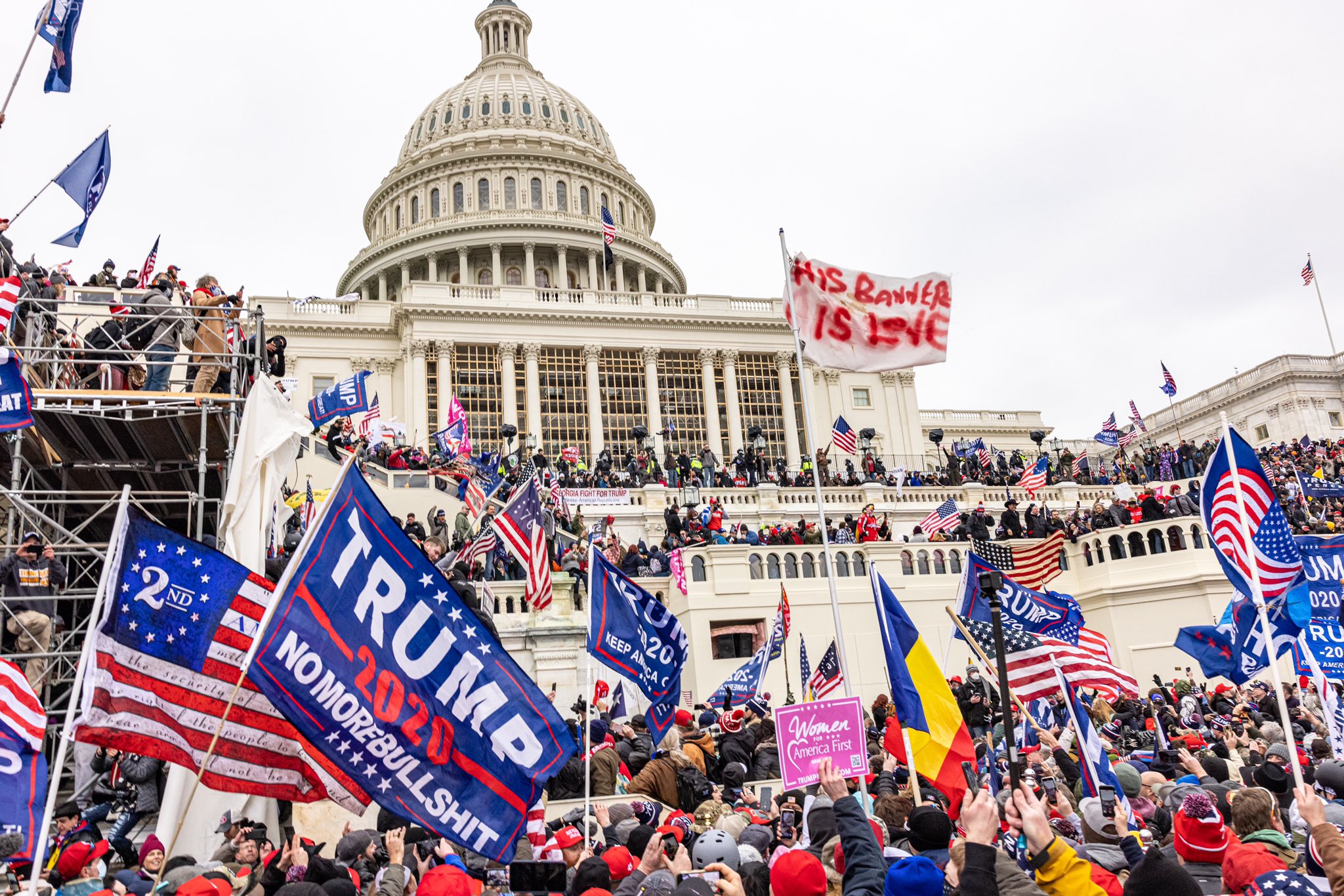
America is Collapsing, January 6, 2021 Capitol riot.
by Mike Holly
December 3, 2025
Why have yields on 2-year, and more recently 10-year, Treasuries been falling with interest rate cuts by the Federal Reserve Bank (Fed), even as the U.S. government keeps increasing its debt? Many investors, including those trying to protect retirement savings, have been expecting “bond vigilantes” to demand higher yields for the increased risk of financing the unsustainable U.S. debt, and for the higher yields to stress the economy and stock markets. Actually, they kind of are. U.S. Treasury holdings appear to have stopped growing among domestic and foreign “real money” institutions and households, and even the banks and Fed. "Real money" institutions are long-term investors that manage pooled money on a fully-funded basis, including pension funds, insurance companies, and mutual funds.
The financing of the growing national debt appears to have come down to a Fed scheme to “manufacture” and “warehouse” the sales of Treasuries through hedge funds. The banks operating under Fed regulation in the “repo market” are giving loans to hedge funds into the trillions of dollars at favorable rates and debt-to-equity ratios reaching 100:1. These bank loans used to buy Treasuries are unsustainable as depleting bank reserves lead to rising repo rates. The loans suppress yields, drive out fully-funded and long-term buyers, destabilize the financial system, and could lead to a lengthy depression. But the Fed could respond by buying Treasuries with printed money (quantitative easing or QE), which would lead to something even worse, like hyperinflation or stagflation.
Hedge funds are private investment funds that pool money from high-net-worth individuals and institutions. They are now dominated by a few funds run by multi-billionaires. They seek to generate high returns from stocks, bonds, commodities, and currencies using complex and aggressive strategies, including leverage and derivatives. Because hedge fund investments are leveraged with loans, they aren’t even considered “real” institutional investors. They have also been known to lobby for preferential government policies, and conduct fraudulent activity, insider trading, and market manipulation that harm investors and raise risks to the financial system. Hedge funds (“the new shadow banks”) are now buying U.S. Treasuries at secretive financial centers worldwide.
The name "hedge," which means reducing risk, has become a duplicitous term for arbitrage used for short-term speculation. After 1949, the first hedge funds used a hedging strategy aimed at reducing risk by simultaneously holding assets expected to increase in value while shorting assets expected to decrease. Since the 1980s, the growing U.S. debt has led to the increased sales of Treasury assets. Since the 1990s, hedge funds have used a “basis trade” to profit from the small price difference between buying Treasuries, and the simultaneous sale of Treasuries with futures contracts. Today, extreme U.S. deficit spending and debt has not only led to the risks of hedge funds dominating increased Treasury holdings, but also the risks associated with their hyping and leveraged investments in Bitcoin and artificial intelligence (AI).
History
During 2020 and 2021, the government’s misguided response to Covid-19 led to extremely high budget deficits, low interest rates, and high inflation. After the Consumer Price Index had inflated to 8.5% in March 2022, the Fed raised short-term interest rates from 0.5% to 5.5% by July 2023. Inflation fell, and so did the budget deficit and stock markets in 2022.
But Biden and the Democrats greatly increased budget deficits during 2023 and 2024. The deficit spending, including subsidies for unreliable wind and solar energy, delayed a recession and stock market crash. It provided increased money and perceived dollar devaluation that incentivized speculative investments in the worthless Bitcoin crypto-currency and irrational AI bubbles. It also limited the Fed’s control of inflation and forced higher-for-longer interest rates. They created a “debt doom loop” with high budget deficits, combining with higher Treasury yields, to increase debt interest payments, especially as past debts are refinanced.
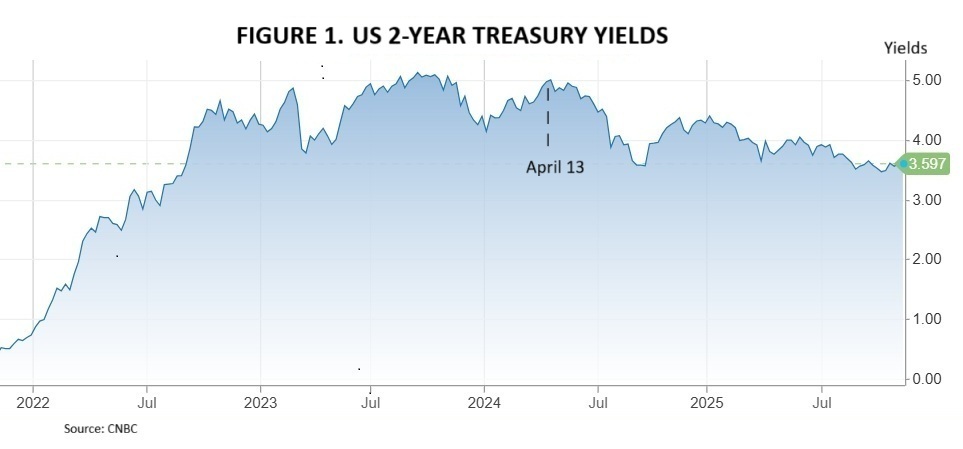
Treasury yields (Figure 1) increased rapidly from under one percent in late 2021, mostly due to high inflation, interest rates, and budget deficits. Two-year Treasury yields reached over four percent from late-2022 to mid-2023, and over five percent from mid-2023 to mid-2024. Yields fell in late 2023 as investors expected the Fed to cut interest rates, but when they didn’t, yields bounced back up in early 2024.
The higher Treasury yields encouraged increased holdings of U.S. Treasuries (Figure 2) by “real” institutions in 2023, and households from mid-2022 to mid-2024. In mid-2024, the banks briefly increased Treasury purchases after the Fed reduced the pace of quantitative tightening (QT). But the Treasury market has needed increased holdings by hedge funds since 2022 and especially mid-2024. In April 2024, the International Monetary Fund (IMF) raised concerns that a small number of highly-leveraged hedge funds could destabilize the Treasury and repo markets.
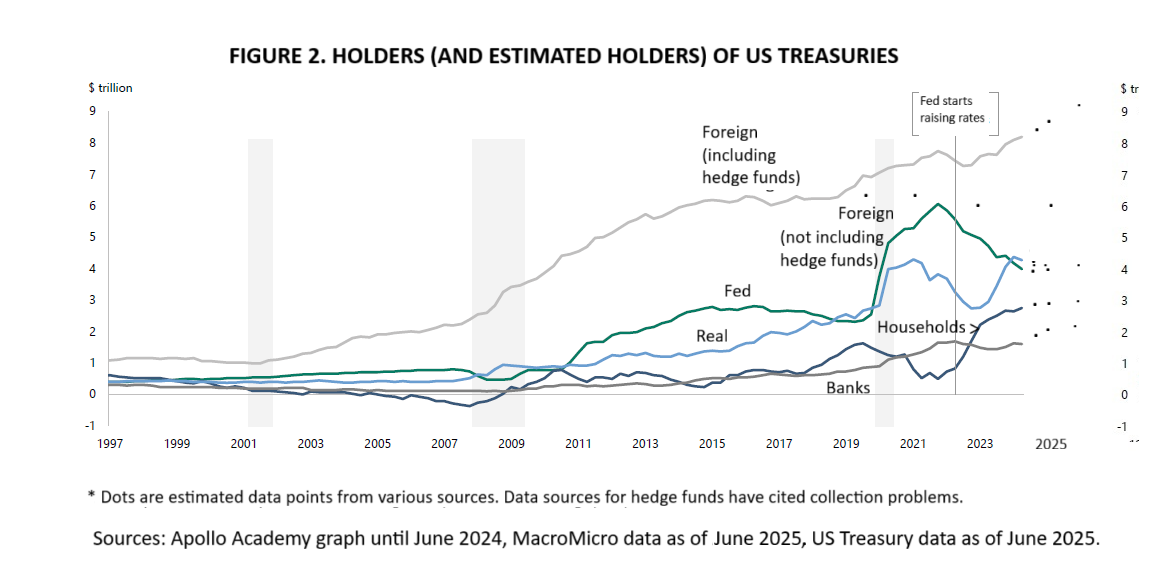
By mid-2024, domestic and foreign “real” institutions and households stopped increasing their holdings of U.S. Treasuries. They haven’t reduced holdings, partly because they are benefiting from rising prices on old bonds with higher yields. Regardless, they still appear to be implicitly demanding higher rates for increased holdings of Treasuries to compensate for the risks of financing the debt, and could dump Treasuries at any time.
Higher interest rates and Treasury yields, and/or lower deficits could have been expected, but the opposite occurred. In September 2024, the Fed began cutting interest rates to about 4% today, despite continued inflation near 3%, which is in excess of the Fed’s goal of 2%. Treasury yields fell to about 3.5%. In 2025, the DOGE initiative was only able to cut minimal government spending. Trump’s tax and spending bill increased future budget deficits by cutting taxes and even increasing spending, especially for defense and immigration control. Spending cuts in health care led to the longest ever government shutdown.
Since mid-2024, hedge funds appear to be dominating the Treasury market. U.S. Treasury reports indicate that, between June 2024 and June 2025, buyers increasing their Treasury holdings were led by major financial centers in the Cayman Islands ($116 B), Belgium ($115 B), and the United Kingdom ($112 B). In October 2025, a Fed analysis found hedge funds in the Cayman Islands (a tax haven) had likely become the largest foreign holder of U.S. Treasuries. However, they reported much of this activity is obscured by basis trades. It is also hidden by confidentiality. Belgium is home to Euroclear, who holds securities for often unknown parties, and the United Kingdom also offers secrecy for hedge funds.
Future
If the Fed stands firm on interest rates against inflation, Treasury and/or stock prices will likely soon fall. A financial crisis would likely start after even a few of the small number of highly-leveraged hedge funds dominating Treasury holdings try to exit concurrently. Treasury prices would fall further, as yields on new bonds rise and send the debt higher. Exits would create a doom loop with a rapid cascade of forced selling to raise cash. Investors would rush to cash, gold and dividend-paying defensive stocks. Hedge funds would default on their bank loans. The defaults could trigger a loss of confidence, credit crunch, widespread panic, bank runs, government bailouts, sharply lower asset values, stock market crash, and severe economic downturn, likely worse than the 2008 Global Financial Crisis and perhaps the Great Depression.
If Trump pressures the Fed to significantly lower interest rates and return to QE (or if the Fed just capitulates on its own), a downturn would be delayed and the AI stock bubble would be pumped up even further, to the benefit of the Trump family and other wealthy. It would also allow default repayment of the National debt with devalued dollars, which along with tariffs may reduce the trade deficit, while increasing stagflation pressures. The Trump family and their crypto supporters would continue benefiting from dollar devaluation using schemes promoting Bitcoin with sales in Stablecoin backed by increased purchases of Treasuries. Trump also plans to deregulate the banks, especially the Supplementary Leverage Ratio and likely force banks to purchase more Treasuries at low rates, and sell shorter duration Treasuries (e.g., like Berkshire Hathaway is buying). Trump’s policies, including immigration control, would lead to continually increasing consumer and home prices toward hyperinflation and economic collapse. Some investors are already fleeing to physical gold and diversifying to more stable foreign currencies. However, Trump’s K-shaped economy is likely politically unsustainable since inflation is hurting far more voters than those benefiting from the AI stock bubble.
If the Democrats regain control of the government, they would likely raise taxes greatly like those in the 1930s through 1970s. High taxes would discourage investment, and when combined with QE, would result in the dreaded stagflation, economic stagnation combined with inflation, like the 1970s. But this time, the massive national debt will make escape from stagflation much more difficult, because raising interest rates to slow inflation would lead to prohibitive interest payments. Moreover, increased QE would be hyperinflationary. Stock and home values will stagnate (especially adjusted for inflation), perhaps for decades, as investors favor commodities like metals, oil, and foodstuffs.
Showing 1 reaction